Almost every piece of life advice you've ever received shares a hidden shape: it's a track. Become a doctor. Follow your passion. Get the stable job. Go to the better school. Each one is a single rail laid out in front of you, and the implied promise is that if you stay on it, you arrive somewhere good.
The trouble is that tracks are a lie of omission. They show you one outcome — usually the highlight-reel one — and quietly delete everything else that could happen along the way. The doctor track doesn't mention the decade of debt, the burnout rate, or the 1-in-something chance you decide three years in that medicine isn't for you. The follow your passion track doesn't price the version where the passion doesn't pay rent.
Real life isn't a track. It's a tree.
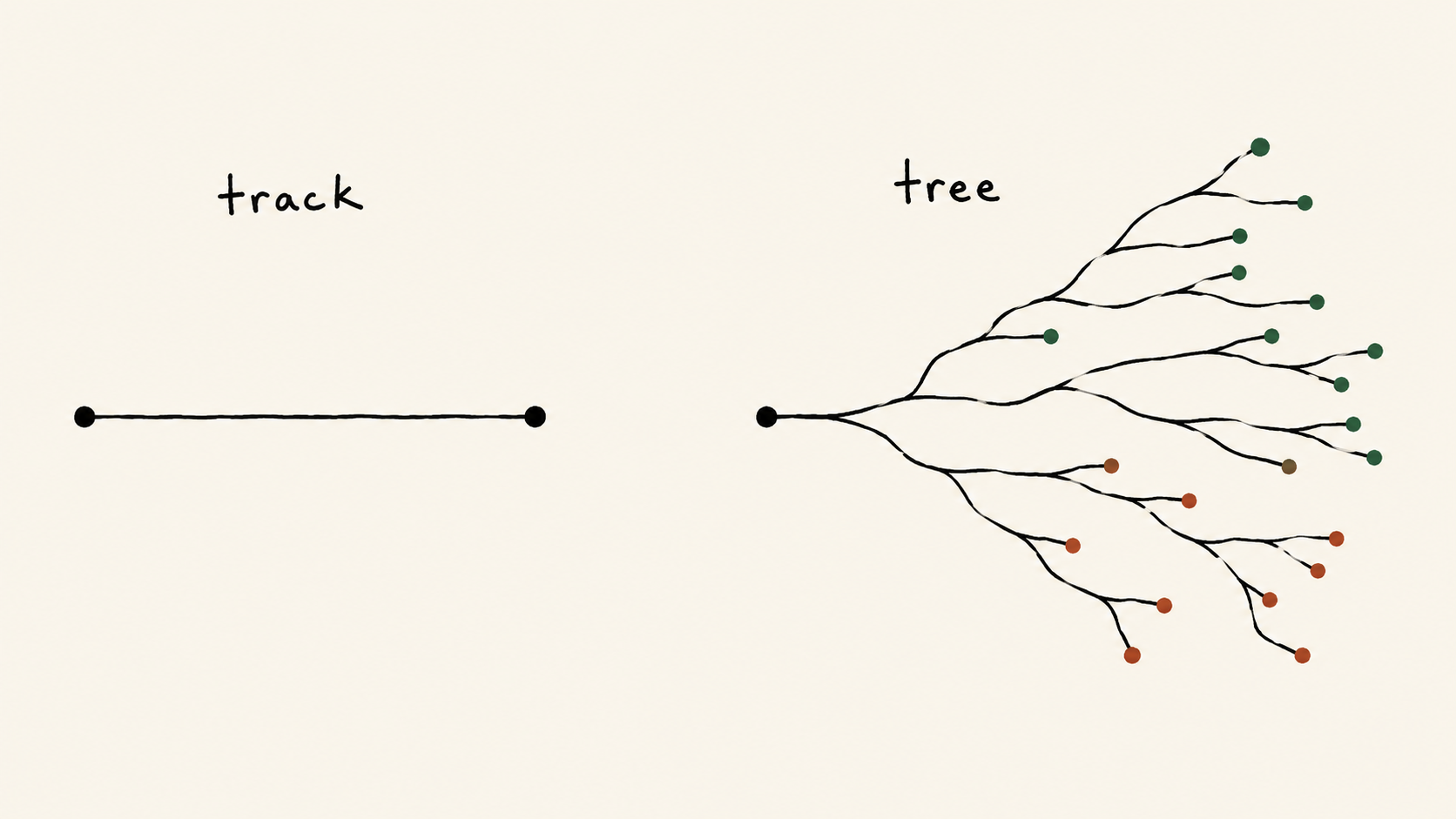
The shape of an actual life
You stand at a root: you, today. From there, the future forks. Some forks are decisions you make — take the job in a new city, go back to school, start the company. Others are chance outcomes you don't control — the field thrives, or the industry contracts and you're laid off. Each branch leads to a new node, and from each node, the future forks again. Move to the new city, and then the startup either IPOs or folds, and then you either land softly or you don't.
It's just what a sequence of conditional, uncertain events looks like when you draw it. The popular “life paths” visualization — the sprawling hand-drawn tree of every life you could plausibly lead — went viral precisely because it felt true in a way that the single-track advice never does.
The branches you'd rather not look at
Here's the part most planning tools get wrong: they only ever draw the good branches. They model the promotion, the raise, the portfolio compounding at 7% forever. They are, in effect, very sophisticated tracks.
But the value of seeing the whole tree is precisely that it includes the unlikely-but-possible bad branches — the layoff, the burnout, the move that doesn't work out — and their odds. A branch with a 15% chance of going badly is not the same as one with a 1% chance, and you cannot reason about that difference if the bad branch isn't even on the page. Pretending the downside doesn't exist doesn't make you brave. It makes you blind.
This is the core of decision-tree and expected-value thinking: you don't evaluate a choice by its best case or its worst case. You weigh every branch by how likely it is and how much you'd value landing there, and you look at the whole distribution of where you might end up. A choice with a slightly lower peak but far less catastrophic downside is often the better bet — but only if you've actually drawn the downside.
Two axes, not one
There's a second thing tracks flatten: they measure success on a single axis, almost always money. But the branch where you're rich and miserable is a genuinely different outcome from the branch where you're rich and content, and any model that can't tell them apart is missing half the picture.
So draw the tree on two axes. Put net worth on one — a stock that compounds forward through every branch. Put wellbeing on the other — how good the years actually feel as you live through them. Now each branch carries both numbers, and you can finally see the four corners: rich-and-content, rich-and-miserable, poor-but-fulfilled, and the one nobody wants. The highlight-reel track only ever showed you one corner.
You can actually draw this
The reason we settle for tracks is that drawing the tree by hand is hard. Holding a dozen branches, their probabilities, and two outcome axes in your head at once is genuinely beyond what a human brain does well. So we don't — we grab the nearest track and hope.
But "beyond what the head does well" is not the same as impossible. The whole tree — every branch, its odds, and where each one lands on both axes — is exactly the kind of thing you draw on a page and let arithmetic carry the rest. Once it's drawn and computed, the downside branches stop being vague dread and become numbers you can weigh against everything else.
You were always going to walk one path through the tree. The only question is whether you saw the tree first, or just the track someone handed you.
Wait But WhyHow to Pick a Career (That Actually Fits You)The Open University · OpenLearnDecision trees and expected value — a primer