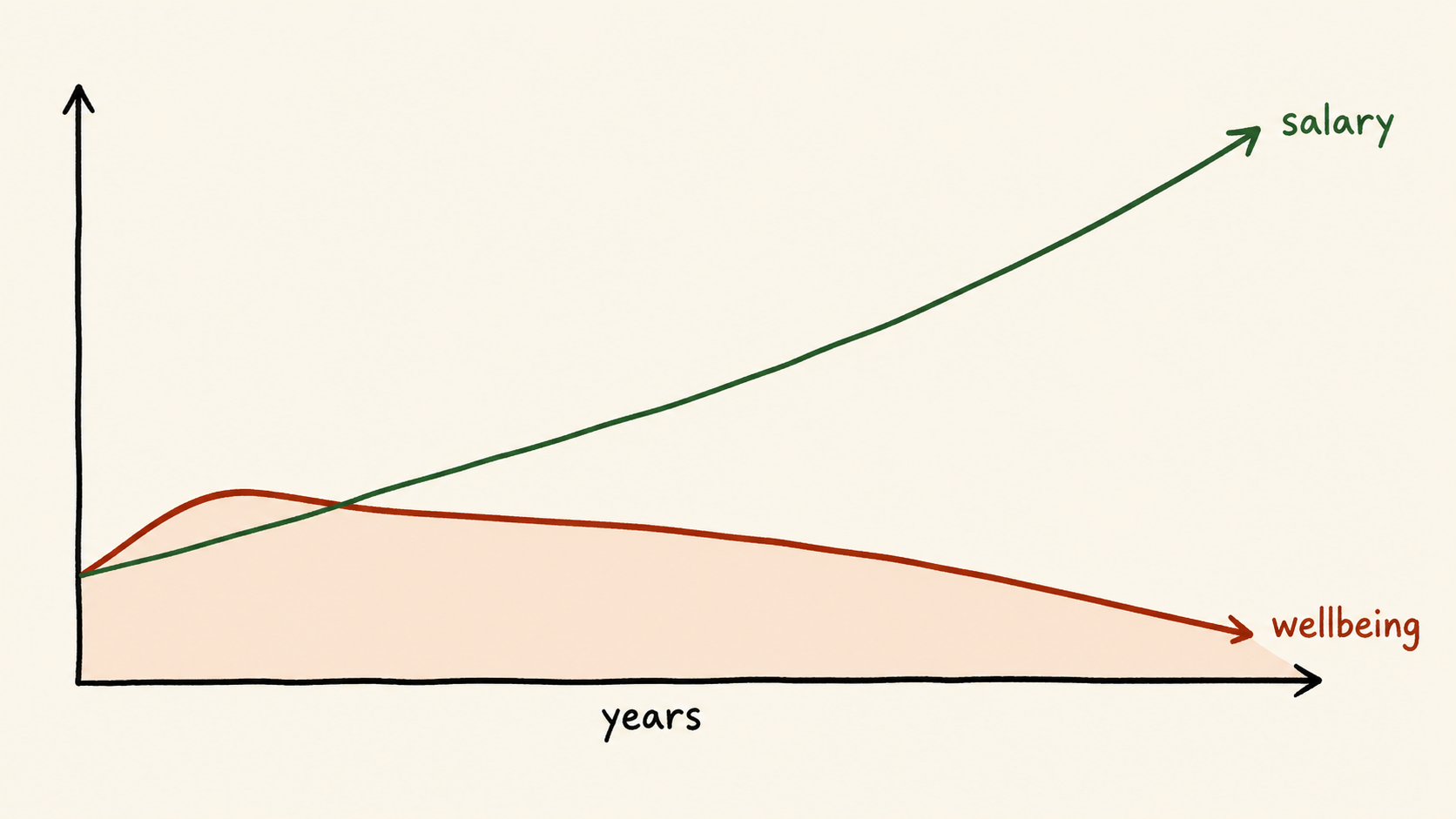
Skills, relationships, health, identity — the assets nobody puts on a balance sheet compound just as ruthlessly as money, and just as quietly. But the same arithmetic runs in reverse, too. Every raise, house, and title slides back toward the baseline you started from. And golden handcuffs let a high salary slowly hollow out the years it's buying: each year you stay for the money, net worth climbs while the wellbeing curve sags — a high salary can compound negatively in the only currency you can't earn back. Chasing a single peak misses the point of the whole thing, which is the area under the curve over time — the wellbeing-years you actually accumulate.
The assets nobody balance-sheets
The reason a small monthly contribution becomes a fortune is that growth feeds on growth: this year's returns become next year's principal, and the curve bends upward on its own. Everyone knows this about money. Almost nobody draws the same curve for the rest of their life.
But they should, because the same engine runs underneath skills, relationships, reputation, and health. A skill you practice this year makes next year's learning faster — competence stacks on competence the way returns stack on principal. The friend you invest in for a decade is not ten times the friend you invested in for one year; trust and history compound into something you couldn't buy at any price. Health works the same way, just slower and more forgivingly until it isn't. None of these show up on a net-worth statement, and all of them obey the same exponential math you already trust with your savings.
So the first move is just to take compounding seriously everywhere, not only in the brokerage account. The thirty-year-old picking the job that pays 20% more over the one that teaches more is making a compounding bet, whether they've named it or not.
Happiness leaks
Here's where the money analogy breaks, and the break is the whole point.
Money, left alone, doesn't decay. Happiness does. Every raise, house, and title slides back toward the baseline you started from — psychologists call it the hedonic treadmill, and that's all you need to know about it. The new salary thrills you for a season and then becomes the floor you measure the next disappointment against. The bigger house is astonishing for a month and ordinary by spring.
That's not a tragedy and it's not a reason for despair. It's just a property of the system, the way friction is a property of a moving object. It means a wellbeing graph isn't a balance that only goes up. It's a level you have to keep feeding, because it's always quietly draining back toward neutral.
Golden handcuffs are negative compounding
Now put those two facts next to each other — things compound, and happiness decays — and you get the trap almost nobody sees coming.
Take the job you'd leave tomorrow if it paid less. The money is real and it compounds: every year you stay, the savings grow, the equity vests, the number on the statement climbs. That's the visible curve, and it's genuinely going up.
But there's a second curve running underneath, and it's pointed the other way. The skills you'd build elsewhere don't build. The relationships you'd be deepening stay shallow. The version of you that the other path would have grown into never gets started — and every one of those is a compounding asset, so a year of not investing isn't a year lost, it's a year subtracted from a curve that should have been bending upward the whole time. Meanwhile the salary that's holding you there has already faded into the baseline; it stopped making you happier years ago. The years a high salary buys are, quietly, the years it spends.
That's the thing the phrase "golden handcuffs" gets right that the spreadsheet never will. Staying for the money isn't neutral. It runs the compounding machine in reverse on everything the money was supposed to be for. The wellbeing curve doesn't just flatline — it sags a little more each year, because the assets that would have lifted it are themselves being starved. It's compound interest, paid by you, to the future you'll never have.
The area under the curve
All of which points at a different thing to optimize.
The instinct is to chase a peak — the big title, the year everything finally arrives, the number that means you made it. But a peak is a single point, and you don't live at a point. You live across the whole span, year after year, and what you actually accumulate is the area under the curve: all the years of how-it-actually-felt, summed up. Call them wellbeing-years. A brilliant year that costs you a decade of sag is a bad trade, even though the peak looks great in the photo.
This is why two lives can look identical on the only axis most of us track and be wildly different lives. One path can win decisively on net worth and lose badly on the area under its wellbeing curve — richer at the end, and emptier the whole way there. The reverse happens too: the path that earns less buys back years of curve that no raise could have. You can't see that trade on a single axis. You have to draw both — the money compounding forward, and the wellbeing accumulating underneath it — and look at the area each one actually buys.
Most of us never draw it. We track the one curve we were handed and drift into the trade we can't see. But the trade is there either way. The only question is whether you priced it, or just paid it.
WikipediaThe hedonic treadmill — why happiness drifts back to baseline80,000 HoursWhat makes for a dream job (based on 60+ studies)