The 2 a.m. problem
You know the feeling. It's late, and you're lying awake turning over The Decision — the job, the city, the house, the leap. At some point you do the responsible thing and make a pro/con list. Two columns. Bullet points. And then you stare at it and feel exactly as stuck as before.
Here's the thing about the pro/con list: it was never going to work. Because the thing you are actually trying to do is not weigh five bullet points against four bullet points. It's to compare two entire futures — two decade-long stretches of a human life, each with its own arc of money, stress, freedom, luck, and quiet Tuesday afternoons — and decide which one you'd rather live.
A list cannot hold a future. It's the wrong shape for the job.
The right shape is a tree. Tim Urban drew it best: your past a fixed thicket of lines behind you, the future fanning out ahead into branching possibilities still open. It went viral because it's true to the felt experience. But a diagram is a poster, not a tool — it can make you feel the weight of the fork; it can't help you walk it. That gap, between seeing the tree and being able to compute it, is what this essay is about.
The strange asymmetry
Here's the part that should bother you more than it does. We model trivial things with enormous rigor and enormous things with vibes.
A company will build a three-tab spreadsheet, complete with sensitivity analysis, to decide whether to buy a $40,000 piece of equipment. A person will decide which of two decades to live — which city, which career, which version of themselves — with what amounts to a mental coin-flip and a gut feeling at 2 a.m. The stakes make it almost comically backwards: a handful of forks account for most of the variance in how an entire life turns out, and they are precisely the decisions we bring the weakest tools to.
We don't under-tool our big decisions because they're unimportant. We do it because of two obstacles that look fatal and aren't.
The first is that the thing that matters most isn't a number. The whole point of a good life is that it feels good — and "how good it feels" doesn't come with units. So people conclude the important variable is unmeasurable, and from there it's a short hop to not modeling anything at all. Money is legible, so money quietly hijacks the decision, and you end up optimizing the one variable you can see while flying blind on the one you actually care about.
The second is that the futures are uncertain and dynamic. The new career might pay off spectacularly — or the industry might contract and lay you off two years in. The move comes with a ramp-up where things get worse before they get better. A static list flattens all of this into nothing. It has no way to say "this path is better in expectation but riskier," which is the actual texture of every real decision.
The insight that makes it computable
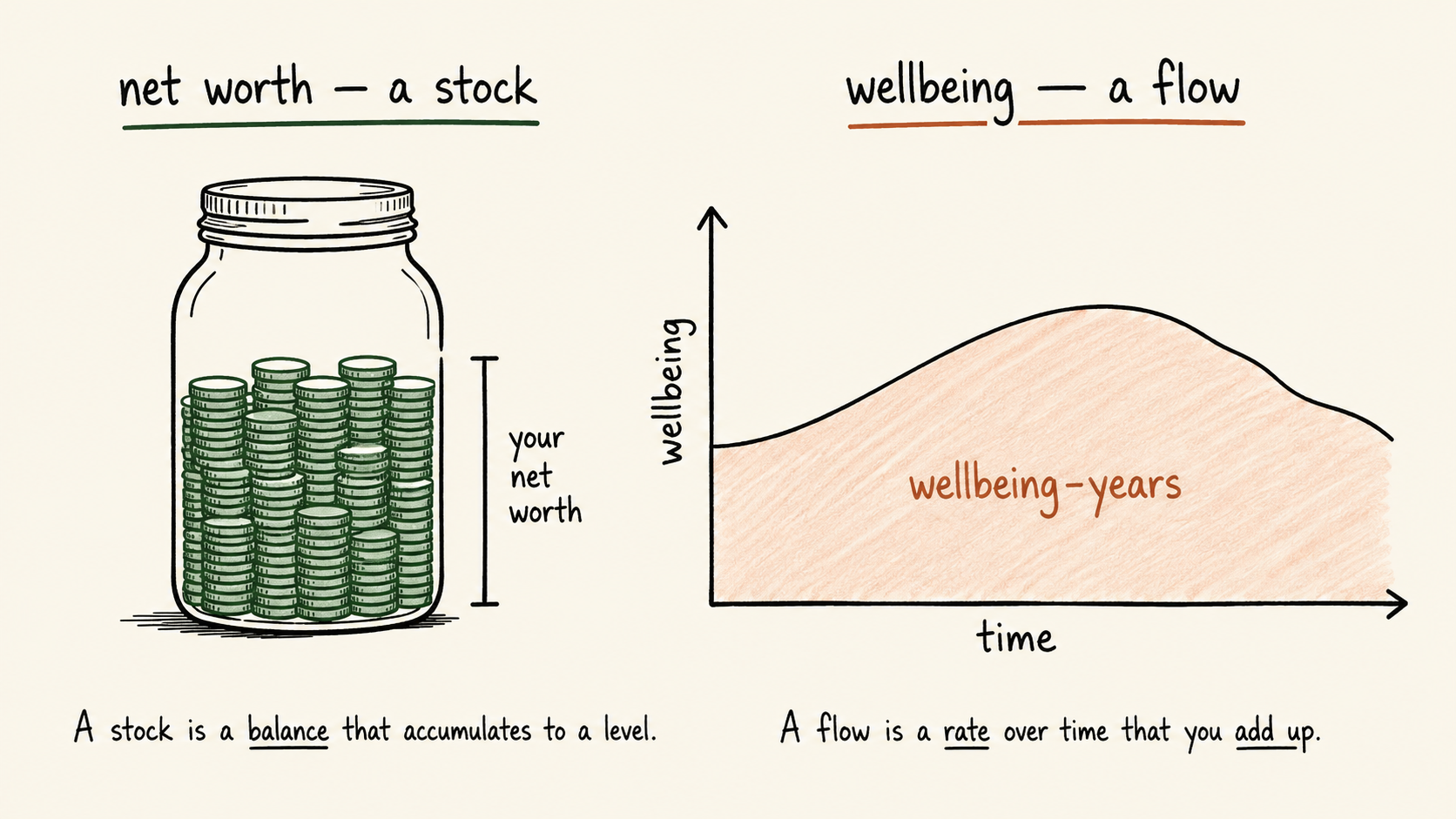
Start with the harder obstacle — wellbeing. The trick is to stop treating money and happiness as the same kind of thing. Net worth is a stock: a balance that accumulates, measured in dollars. Wellbeing is a flow: a rate, how good life feels per unit of time. You can't add a stock to a flow any more than you can add your bank balance to your heart rate. The units don't reconcile.
But you can integrate the flow. Add up how good life feels, moment after moment, over the years a path lasts, and you get the area under your happiness curve — call it wellbeing-years. That's a stock-shaped quantity. Once both things are stock-shaped and on a common scale, "which life is better, all things considered" becomes a real, honest computation:
Utility = (your weight on wealth) × money + (your weight on wellbeing) × accumulated wellbeing
Nobody else gets to set the weights. Whether you'd trade money for time, or stability for meaning, is the most personal thing about you, and no model should decide it for you. The arithmetic, though — propagating dozens of assumptions forward across a branching, probabilistic tree, every time you nudge a number — is exactly the part you genuinely cannot do in your head. That's the part worth handing off.
The second obstacle, uncertainty, falls out of the same move. Give each fork a probability, and the career that might take off and might fold stops being a thing you have to pretend you know. You weight the futures instead of guessing between them.
The honest part
A model is not a crystal ball, and any product in this space that pretends otherwise is lying to you. The output is exactly as good as the assumptions you feed it. The map is not the territory.
But here's the quietly important thing: the number is not actually the point. The deepest value of building the model is that it forces your assumptions into the open. You have to say out loud how much you think the new field pays, how likely the layoff really is, how much the move would cost you in happiness before it pays you back. The act of making those guesses explicit — and arguing with them, and watching the tree reshape when you do — is where the clarity comes from. Often you'll discover which branch your gut was quietly rooting for the whole time, just by noticing which assumption you kept fiddling with to make it win.
It matters because the big decisions don't come with do-overs. You get exactly one walk through the tree. There is no A/B test on your own life, no control group, no undo on the fork you took in your thirties. When you can't visit the road not taken, the closest thing you can build to a second opinion is a model of it.
The map is not the territory. But almost everyone facing these forks is crossing the territory with no map at all.
The fork is still in front of you
So go back to the diagram. The lines behind you are fixed — that part's done, and worrying at it is wasted motion. But the fan to the right is still open, still branching, still entirely in your hands. You were always going to have to choose down it half-blind. That's the human condition; we can't fix that.
We can just hand you a light.
Wait But WhyHow to Pick a Career (That Actually Fits You)80,000 HoursThe 80,000 Hours career guide