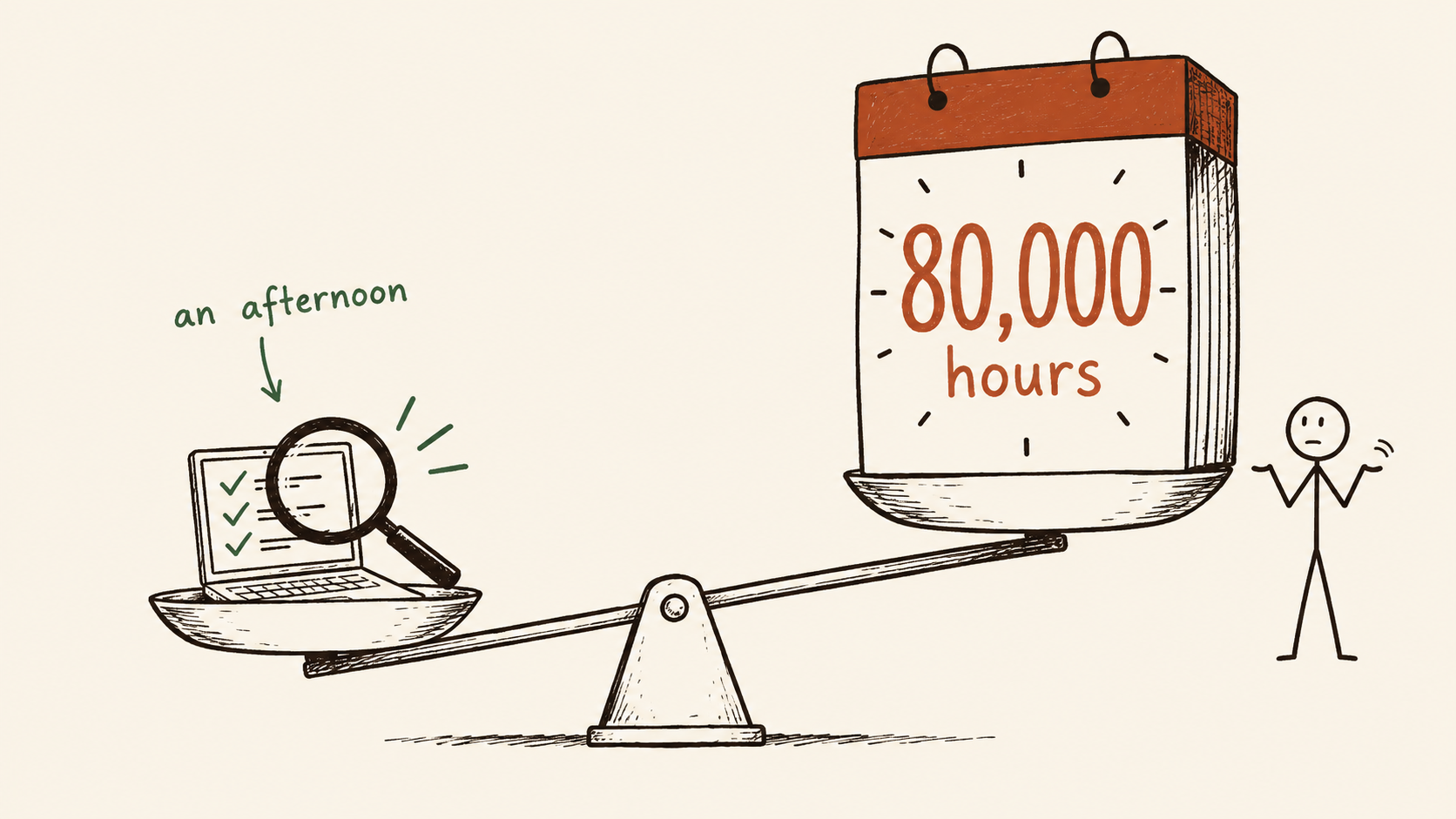
Over a career you'll work something like 80,000 hours and move millions of dollars through your hands. It is, by almost any measure, the single decision that moves the most money and the most of your time. And yet the choice that steers it — what to do, where, for whom — routinely gets less deliberate analysis than buying a laptop, where people happily read reviews for an afternoon over a few hundred dollars. The asymmetry is almost embarrassing once you say it out loud, and so is the fix. A few hours of explicit modeling buys clarity on a decision worth thousands of times the laptop.
The laptop gets the spreadsheet
Watch how someone buys a laptop. They open six tabs. They compare battery life and screen and weight. They read a review by a stranger who tested the hinge ten thousand times. They sleep on it. The whole ritual costs an afternoon and steers maybe a thousand dollars over three years.
Now watch the same person choose a career, or change one. There's a conversation with a friend. A gut feeling. A job that happened to be open when they happened to be looking. Maybe a salary number, checked once. And then they commit — to a path that, depending on the field, separates into lifetime earnings that can differ by well over a million dollars, and into tens of thousands of hours of their one life.
The laptop gets the spreadsheet. The career gets a shrug. We have the analytical machinery; we just point it at the wrong target.
Why the big one goes unexamined
It's not that people are lazy about the things that matter. It's that the career decision is engineered, almost perfectly, to evade scrutiny.
It's distant. The payoff and the regret both arrive years later, and the brain discounts anything that far out into a fog. It's abstract — there's no object to hold, no hinge to test, just a future that hasn't happened yet. It's uncertain in a way that feels like it can't be analyzed: the industry might thrive or contract, you might love the work or burn out, and so the whole thing gets filed under "who can say." And it's irreversible enough to be scary, which makes people want to think about it less, not more.
But the real culprit is structural. The laptop has a checkout button. At some point you must click buy, and that click is a forcing function — a single moment that concentrates all your deliberation into one place. The career has no checkout button. You drift into it. You take the internship, which becomes the job, which becomes the field, which becomes the decade, and no single moment ever announced itself as the decision and demanded you think hard. The most consequential choice of your life gets made by a thousand small defaults, none of which felt like a choice at all.
What a slightly wrong answer costs
Here's why the shrug is expensive. The career decision doesn't cost you once — it compounds.
A laptop you got slightly wrong is a mild annoyance for three years and then it's gone. A career you got slightly wrong is wrong for 80,000 hours. A path that pays a little less, or fits a little worse, or carries a little more risk than you'd have accepted if you'd looked, doesn't deduct a flat fee. It deducts a percentage, every year, off a number that runs for decades — off both your earnings curve and your actual experience of being alive. Small differences in a starting trajectory don't stay small. They fan out.
That's the cruel math of the unexamined choice. The cost of getting it wrong scales with exactly the thing that made you avoid examining it: its size and its duration. The bigger and longer the decision, the more a small error compounds — and the more it was worth thinking about in the first place.
The cheapest leverage you'll ever get
So flip it around. If a slightly-wrong career compounds its cost across decades, then a slightly-better one compounds its benefit across decades — and the thing that nudges you from one to the other is just deliberation. A few hours of it.
This is what decision analysts call the value of information: before you commit, it's worth paying for whatever knowledge would change your decision, up to the value of the better choice it unlocks. Against a thousand-dollar laptop, an afternoon of reviews is about the right price. Against a multi-million-dollar, multi-decade career, a few hours of actually laying out the options is so cheap it barely registers — and the thing it can unlock is enormous.
What do those hours buy, concretely? They surface the assumptions you were running on silently — the salary you assumed, the growth you assumed, the odds you never named. They put the bad branches on the page next to the good ones, with their probabilities, so a 15%-chance downside stops being vague dread and becomes a number you can weigh. And they leave you with a comparison you can actually defend to yourself later — I chose this knowing that — instead of a story you tell after the fact about why the thing that happened to you was secretly what you wanted.
The analysis is hours. The decision is decades. There is no other choice in your life where a little deliberation pays back so much — and almost no one spends it.
You'll read six reviews before you buy the thing you'll forget in three years. The least you can do is draw the one you'll live inside for forty.
80,000 HoursYou have 80,000 hours in your career — the founding stat, and the case for taking the decision seriouslyThe Hamilton Project · BrookingsMajor Decisions: what graduates earn over their lifetimes — how far the paths divergeWikipediaExpected value of perfect information — what it's worth to know before you choose